Understanding WIP is essential for businesses aiming to streamline operations, improve cost control, and accurately assess production efficiency. This article of Key Logistics below will explore the definition of WIP, provide real-world examples, outline the formula used to calculate it, and highlight its strategic benefits.
What is work in process inventory (WIP)?
Work in process (WIP) inventory refers to goods that are in various stages of production but are not yet completed. WIP encompasses raw materials that have entered the production line and are being transformed into finished goods. This inventory type is critical in manufacturing and distribution environments where multiple phases of production, assembly, and inspection occur before final products are ready for shipment.

How to calculate work in process inventory (WIP)?
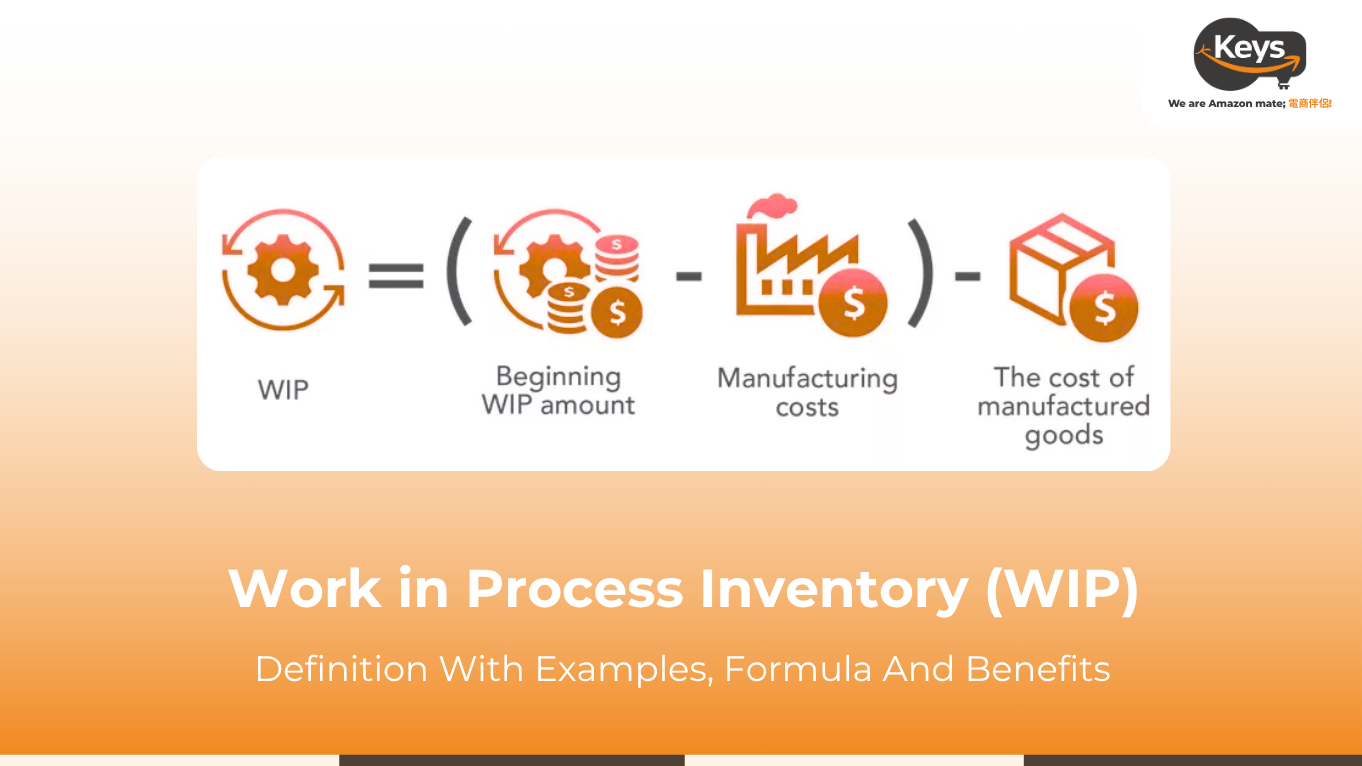
An accurate WIP calculation helps logistics teams anticipate capacity needs, detect inefficiencies, and ensure a seamless flow from raw materials to finished goods. The standard formula used to determine WIP inventory is:
Beginning WIP Inventory + Manufacturing Costs – Cost of Goods Manufactured (COGM) = Ending WIP Inventory
Example: Suppose you manage a factory that produces custom kitchen appliances. At the start of the quarter, the beginning WIP inventory is valued at $75,000. Over the course of the quarter, your team incurs $200,000 in manufacturing costs due to specialized components, labor, and operational overhead. At the end of the quarter, the cost of goods successfully manufactured and ready for delivery is $220,000.
Now, apply the formula:
$75,000 + $200,000 – $220,000 = $55,000
WIP inventory is classified as a current asset on the company’s balance sheet. Each stage of the production process must be reflected financially by recording the incremental costs associated with it. This includes the transfer of raw materials into production, application of labor, and allocation of factory overhead. These costs accumulate in the WIP inventory account until the items are completed and moved to finished goods inventory.
To get a deeper acknowledgement, you can follow the example below:
| Date | Description | Debit | Credit |
| 3/4/2025 | Procure steel components from supplier | Raw Materials Inventory – $8,500 | Accounts Payable – $8,500 |
| 3/7/2025 | Release steel to assembly line | WIP Inventory – $8,500 | Raw Materials Inventory – $8,500 |
| 3/11/2025 | Apply welding labor and machine operation cost | WIP Inventory – $6,200 | Wages Payable – $4,500Factory Overhead – $1,700 |
| 3/16/2025 | Complete semi-trailers and move to finished stock | Finished Goods Inventory – $14,700 | WIP Inventory – $14,700 |
| 3/21/2025 | Invoice wholesale client for delivered goods | Accounts Receivable – $20,000 | Sales Revenue – $20,000 |
| 3/21/2025 | Record expense for goods sold | Cost of Goods Sold – $14,700 | Finished Goods Inventory – $14,700 |
3 key metrics required to determine your existing WIP inventory
Beginning work in process inventory cost
The beginning WIP inventory cost is the value of partially completed goods carried over from the previous accounting period. This metric is sourced from the asset section of the prior period’s balance sheet and serves as the starting point for the current period. To determine this figure, you use the ending WIP inventory from the last period, which becomes the beginning WIP for the current period.
Cost of manufactured goods
The Cost of Manufactured Goods (COGM) represents the total cost to complete the finished products during a specific period. It’s calculated using the formula:
Total Manufacturing Costs + Beginning WIP Inventory – Ending WIP Inventory = COGM
For logistics professionals, understanding COGM enables them to optimize inventory valuation, enhance freight planning, and ensure alignment between production capacity and outbound logistics. It also supports more accurate cost-to-serve modeling by capturing the transformation cost from raw materials to finished products.
Manufacturing costs
Manufacturing costs encompass all the expenditures required to convert raw materials into semi-finished or finished goods. These costs include raw materials, direct labor, and manufacturing overhead. The standard formula is:
Raw Materials + Direct Labor Costs + Manufacturing Overhead = Manufacturing Costs

How Work-In-Process Inventory (WIP) impacts Supply Chain Performance
Work-in-progress (WIP) inventory has a significant impact on supply chain performance, affecting operational costs, production planning, and capital allocation. Although WIP is not immediately visible like finished goods, it is still recognized as an asset on the balance sheet. Excess WIP can be a red flag for production bottlenecks and inefficiencies in material flow. Holding too much WIP ties up working capital in unfinished goods, drives up storage costs, and limits warehouse space that could otherwise be used for revenue-generating finished products.
From a logistics standpoint, efficient WIP management enables better cost control and production planning. Real-time visibility into WIP levels allows for timely resource allocation, cost driver identification, and adherence to just-in-time (JIT) principles. Minimizing WIP helps reduce the risk of product damage or loss during processing and enhances quality control across manufacturing stages. Ultimately, controlling WIP inventory supports a leaner, more responsive supply chain and improves overall profitability.
Comparisons to Work in Progress and Work in Process?
In logistics and supply chain operations, the terms Work in Progress (WIP) and Work in Process are often used interchangeably, but they carry subtle distinctions depending on the industry context. In manufacturing logistics, Work in Process typically refers to items that are actively moving through a production line, such as goods being assembled in a multi-stage operation. On the other hand, Work in Progress is more common in project-based workflows, like custom machinery or construction, where the work is not part of a continuous flow but is instead tracked across longer-term stages.
| Feature | Work in Progress (WIP) | Work in Process |
| Typical Use Case | Custom or project-based production | Mass production or continuous flow |
| Industry Application | Construction, shipbuilding, custom logistics | Manufacturing, automotive, electronics |
| Inventory Handling | Tracked over longer time periods | Moves quickly through production stages |
| Logistics Implication | Irregular inventory scheduling | Predictable movement for JIT logistics |
| Documentation Focus | Project tracking and job costing | Production orders and BOM tracking |
Benefits of well-managed WIP inventory
When WIP is tracked and optimized effectively, businesses can:
- Optimize production flow: Minimize bottlenecks and idle time on the production line to ensure a steady flow of goods.
- Reduce costs: Avoid overproduction and excess storage, which helps cut carrying costs and improves cash flow.
- Improve resource allocation: Allocate labor, machinery, and materials more efficiently by knowing exactly where each order stands.
- Enhance quality control: Early detection of defects or process inefficiencies reduces scrap and rework.
- Create accurate financial reports: Real-time WIP valuation ensures that financial statements reflect true operational costs.
- Enhances forecasting and planning: Better visibility into production stages improves demand planning and inventory replenishment.
- Increase customer satisfaction: Faster lead times and fewer delays lead to more reliable deliveries and stronger customer trust.
- Get a more accurate valuation of your business: Investors and stakeholders can better assess asset value when WIP is precisely recorded.
- Save time: Reduce manual tracking and troubleshooting by implementing streamlined WIP monitoring systems.

Ways to optimize the flow of work-in-process inventory
Source the right supplier
Selecting the right supplier is crucial in maintaining a smooth flow of work-in-progress (WIP) inventory. A reliable supplier ensures consistent lead times, minimizes production delays, and reduces the risk of stockouts. When sourcing, prioritize suppliers with a strong track record in on-time delivery, quality control, and responsiveness to demand fluctuations. Building strategic supplier partnerships also enables better coordination on reorder points, safety stock levels, and production scheduling.

Use a 3PL to support to inventory management
Partnering with a third-party logistics (3PL) provider can improve how WIP inventory is handled and stored across your supply chain. A competent 3PL offers warehousing solutions, cross-docking capabilities, and just-in-time (JIT) delivery services that reduce bottlenecks between production stages. By outsourcing non-core logistics functions, businesses can focus internal resources on production efficiency while maintaining lean inventory levels.
3PLs also provide inventory tracking systems and real-time data analytics that enable better forecasting and demand planning. This visibility helps reduce excess inventory, minimize holding costs, and improve overall throughput. Whether managing buffer stock or coordinating inter-facility transfers, a 3PL ensures that WIP materials move efficiently from one processing stage to the next, supporting continuous production flow with minimal disruption.
Why tracking work in Process Inventory (WIP) is essential?
Tracking Work in Process (WIP) inventory is crucial for maintaining visibility and control throughout the supply chain. Effective WIP monitoring allows logistics managers to optimize throughput, balance workload across production lines, and improve overall inventory turnover. It also enhances demand forecasting accuracy by providing up-to-date data on available and soon-to-be-finished stock. With tighter control of WIP, companies can reduce excess inventory, lower holding costs, and respond faster to shifting customer requirements.
FAQ: WIP
What is work in process WIP inventory?
Work in process (WIP) inventory refers to goods that are currently in production but not yet completed. In a logistics and supply chain context, WIP includes raw materials that have entered the production line and are undergoing transformation but are not ready for sale or final delivery.
How do you account for work in process inventory?
Work in process (WIP) inventory is accounted for as a current asset on the balance sheet and tracked throughout the production cycle. Accurate accounting involves calculating the value of raw materials, labor, and overhead costs incurred up to a specific point.
What is the work in process inventory movement?
WIP inventory movement refers to the flow of partially finished goods through different stages of the production process. This includes tracking the internal transfer of materials, coordinating just-in-time delivery of components, and ensuring timely progress from assembly to packaging.
Understanding Work-in-Process (WIP) inventory helps businesses track the progress between raw materials and finished products. With real-life examples and a straightforward formula, companies can accurately measure WIP and make informed decisions in their production processes. Managing WIP well leads to better resource use, fewer bottlenecks, and improved efficiency throughout the supply chain.


 Tiếng Việt
 中文 (中国)